
When Zimbabwe is introduced to the world, the conversation often begins with Victoria Falls, the ancient stone city of Great Zimbabwe, or the country’s celebrated music and hospitality. Yet beyond these familiar images lies another story , a nation whose identity is woven from many languages, histories, traditions and ways of life.
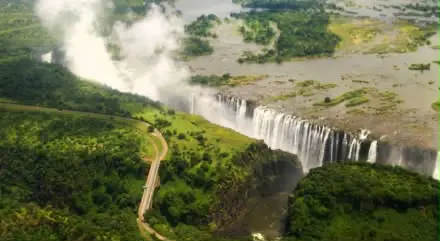
Illustration 1 showing Zambazi Valley.Zimbabwe
(https://share.google/lurmiMzNPfX9brktf)
From the communities along the Zambezi Valley to the cultural landscapes of Matabeleland and the south-eastern Lowveld, Zimbabwe’s diversity is expressed through language, music, food, storytelling, spirituality, traditional knowledge and relationships with the land. These cultural expressions are not simply remnants of the past. They are living identities that continue to shape how communities understand themselves and their place in the world.
Section 6 of Zimbabwe’s Constitution recognises 16 languages, including Shona, Ndebele, Tonga, Kalanga, Nambya, Venda, Shangani, Ndau, Chewa, Chibarwe, Tswana, Sotho, Xhosa, English, sign language and Koisan (Republic of Zimbabwe, 2013). This linguistic diversity reflects a broader cultural landscape that cannot be adequately represented by a single language, tradition or community.
The challenge, therefore, is not merely to celebrate Zimbabwe’s diversity. It is to ensure that every community has meaningful opportunities to preserve, practise and share its heritage without being overshadowed by more widely represented cultural identities.
A Cultural Landscape Shaped by Many Communities
Zimbabwe’s cultural identity is often discussed through its two largest ethnolinguistic communities, Shona and Ndebele. Both have rich and varied histories, artistic traditions and cultural practices. However, a fuller understanding of the country must also recognise communities such as the BaTonga, Kalanga, Nambya, Venda, Shangani, Ndau, Chewa and others whose identities contribute to the nation’s social and historical fabric.
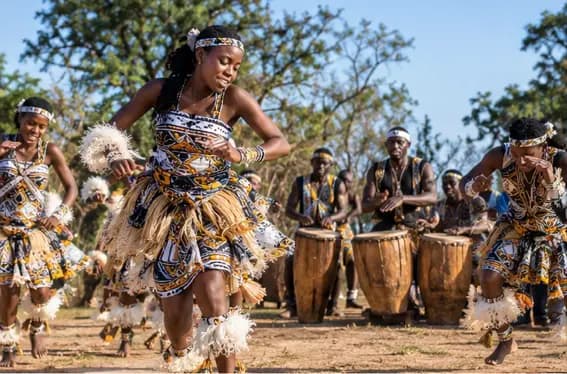
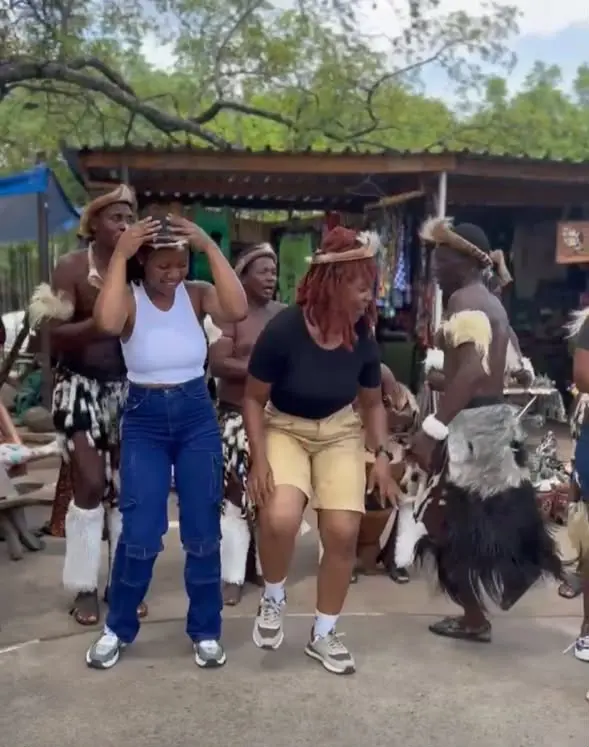
Illustration 2: Traditional dance
These communities are not defined by culture alone; they also possess diverse contemporary experiences, aspirations and ways of adapting to a changing society. Their traditions are not necessarily confined to particular geographical boundaries. Families migrate, languages overlap, communities interact, and cultural practices evolve across generations.
The Tonga communities of the Zambezi Valley, for example, have distinctive linguistic and cultural traditions shaped by their histories and relationship with the Zambezi River. The Kalanga have their own linguistic heritage and historical connections across present-day Zimbabwe and Botswana. In the south-eastern Lowveld, Shangani communities maintain traditions expressed through music, dance, food, storytelling and social practices.
These examples illustrate the diversity of Zimbabwe’s cultural landscape without suggesting that every member of a community shares identical beliefs or practices.
Recognising these identities matters because national unity should not require cultural uniformity. A country can share a national identity while allowing its communities to retain their distinctive languages, histories and traditions.
Cultural diversity is not a competition over which community is most authentically Zimbabwean. It is a recognition that the nation’s heritage is richer because it contains many voices.
When a Language Becomes More Than Words
Language carries more than information. It carries memory, humour, proverbs, family histories, place names, indigenous knowledge and ways of interpreting the world. When a language is used less frequently or disappears, the consequences can extend beyond communication.
The loss of a language may weaken the transmission of oral histories, traditional ecological knowledge and cultural expressions that are difficult to translate fully into another language.
Zimbabwe’s constitutional recognition of 16 languages provides an important foundation for linguistic inclusion. Section 6 also requires the state and government institutions to treat officially recognised languages equitably and to promote the development of languages used in Zimbabwe (Republic of Zimbabwe, 2013). Yet constitutional recognition alone does not guarantee equal visibility in education, broadcasting, publishing, public services or digital spaces.
Research by Jonhera and Nyoni (2023), examining ZBC Television and National FM, highlights concerns about the representation of minority languages in Zimbabwean broadcasting. The authors argue that minority languages have not received adequate space on the two broadcasting platforms they studied.
When some languages dominate public communication, speakers of less widely represented languages may find fewer opportunities to see their experiences reflected in national conversations.
This is not simply a question of how many programmes are broadcast in a particular language. It is also about whose knowledge is considered valuable, whose stories are told, and which communities can participate fully in shaping the national narrative.
Inclusion must therefore extend beyond the formal recognition of languages. It should be reflected in accessible educational materials, community radio, literature, public information, cultural programming and digital content.
A young person should be able to hear their language on the radio, read it in a story, learn it at school and encounter it online. Their mother tongue should not become something to abandon in order to participate in modern society.
Living Heritage: More Than Performances and Monuments
Culture is sometimes presented as a collection of traditional dances, costumes, monuments and festival performances. These expressions are important, but living heritage is much broader.
It includes the knowledge and skills passed from one generation to another, the meanings attached to particular practices, and the relationships that sustain them within communities.
Zimbabwe’s heritage offers powerful examples. UNESCO inscribed the Mbende Jerusarema dance on its Representative List of the Intangible Cultural Heritage of Humanity in 2008. Practised by the Zezuru Shona people, particularly in eastern Zimbabwe, the dance is characterised by distinctive movements, polyrhythmic drumming, clapping and other rhythmic expressions. Its performance and meaning have also evolved over time (UNESCO, 2008).
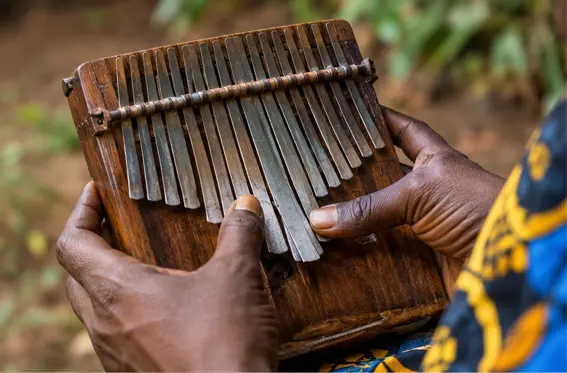
Illustration 3 showing the mbira instrument
In 2020, UNESCO inscribed the art of crafting and playing the mbira/sansi, a traditional finger-plucked musical instrument shared by communities in Zimbabwe and Malawi. The practice encompasses instrument-making, musical performance, the transmission of skills and the cultural meanings associated with the music (UNESCO, 2020).
These examples demonstrate that cultural heritage is not static. Traditions can adapt to contemporary life while retaining significance for the communities that practise them.
They also raise an important question: how can the heritage of communities receive meaningful recognition when it is less visible in national media, tourism, formal education or international cultural platforms?
UNESCO recognition can help increase visibility, but a country’s cultural wealth cannot be measured solely by the traditions that have received international recognition. Many equally meaningful practices are maintained in families, villages, community gatherings and everyday life without formal listings or widespread publicity.
The responsibility to preserve heritage must therefore extend beyond celebrated monuments and internationally recognized traditions.
The Challenge of Being Seen and Heard
Cultural exclusion does not always take the form of deliberate discrimination. Sometimes it develops through ordinary patterns of representation.
A school textbook may discuss national history without sufficiently exploring the experiences of smaller communities. A television programme may repeatedly feature familiar cultural expressions while rarely showcasing others. A museum may preserve important objects without giving the communities concerned enough influence over how their histories are interpreted.
These examples illustrate potential gaps in representation; establishing how widespread they are requires evidence from the relevant institutions and communities.
For minority-language communities, the challenge may be especially significant when younger generations increasingly use dominant languages in education, employment and digital communication. Migration and urbanisation can also change the environments in which cultural knowledge is passed on. These processes do not inevitably cause cultural loss, but they can make deliberate preservation efforts more important.
The answer is not to portray minority cultures as helpless or destined to disappear. These communities are active custodians of their heritage, and their cultures continue to develop. The real issue is whether they have sufficient opportunities, resources and decision-making power to sustain and share their traditions on their own terms.
Cultural inclusion requires more than inviting communities to perform at national events. It requires listening to their perspectives, supporting their cultural initiatives, recognising their languages and enabling them to participate in decisions affecting their heritage.
Most importantly, communities must be treated as partners and knowledge holders, not merely as subjects to be documented.
Can the Digital Age Become an Ally?
Digital technology offers Zimbabwe new opportunities to preserve and share its cultural diversity. Audio recordings can capture oral histories. Digital archives can preserve traditional stories and songs. Online dictionaries and language-learning resources can help younger generations reconnect with their mother tongues. Short documentaries can introduce international audiences to traditions that receive limited media coverage.
Young people can play a significant role in this work. With accessible smartphones and digital platforms, they can interview elders, document local festivals, record traditional music and share community histories with audiences beyond their immediate surroundings.
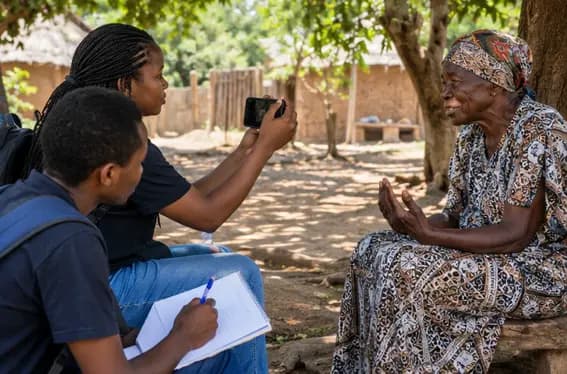
Illustrative scene of a young person recording an elder’s oral history. Community permission and agreed use are essential in real projects.
For example, a youth-led heritage project could collaborate with local language speakers to record approved oral histories, produce a small bilingual digital collection and develop educational material for younger learners. The project could document who contributed each recording, explain its cultural context and establish clear rules governing access and reuse.
Such an initiative should begin with community consultation rather than assuming that every story, song or cultural practice is appropriate for public distribution.Digital preservation is not simply a matter of uploading everything online.
Some cultural knowledge is sacred, private or intended only for particular members of a community. Recording and sharing it without permission can violate cultural protocols, expose sensitive information or strip practices of their original meaning.
There are also questions about ownership. Who controls a recording once it is published? Who receives recognition? Can communities correct inaccurate descriptions, restrict access or withdraw material when necessary? Are their languages represented accurately by digital tools, including artificial intelligence?
Responsible digital preservation must place community consent, attribution, cultural context and decision-making at its centre. Technology should strengthen the ability of communities to safeguard their heritage rather than transfer control of that heritage to outside institutions or online platforms.
This means involving cultural practitioners and relevant community representatives, obtaining informed permission, respecting restrictions on sensitive knowledge and agreeing in advance how materials may be stored, accessed, reproduced and shared.
It also means investing in local-language digital resources so that cultural participation is not limited to those who can communicate in dominant international languages.
The future of cultural preservation will depend not only on what technology can record, but also on whether the people whose heritage is being recorded retain meaningful authority over how it is used.
What Can Young Zimbabweans Do?
Preserving cultural diversity need not begin with a large institution or an expensive national programme. It can begin with small, respectful actions that grow into sustained community initiatives.
Young people can learn languages spoken by their families and neighbours, record oral histories with permission, support local artists and attend cultural events with a willingness to learn. Schools and universities can create opportunities for students to explore the histories and traditions of communities beyond their own.
Journalists and digital creators can broaden representation by reporting on underrepresented communities and consulting people with direct knowledge of the traditions being discussed. Media organisations can expand local-language programming and support content produced by speakers of those languages.
Museums, libraries and cultural institutions can work with communities to develop archives and exhibitions that reflect their perspectives. Policymakers can support mother-tongue education, cultural programming and initiatives that enable minority-language communities to participate in decisions concerning their heritage.
International audiences also have a role to play. They can engage with Zimbabwean cultural stories beyond familiar tourist destinations, seek out community-led resources and recognise that cultural diversity is not merely something to observe. It is something to respect.
Above all, preservation must not be confused with freezing culture in time. Young people should be free to reinterpret traditions, combine cultural influences and create new forms of expression, while respecting the rights of cultural practitioners and any community protocols that apply.
A living culture is not one that never changes. It is one whose people can continue to shape its future.
One Nation, Many Voices
Zimbabwe’s cultural diversity is both a national asset and a shared responsibility. Its significance lies not only in the traditions that attract visitors or receive international recognition, but also in the languages spoken at home, the stories passed between generations, the knowledge held by elders and the cultural expressions sustained by communities across the country.
The measure of a culturally inclusive society is not simply how proudly it celebrates its most visible traditions. It is also how carefully it protects the voices that are less often heard.
A language should not need international recognition to deserve preservation. A community should not need a festival spotlight to have its history respected. And a cultural tradition should not have to become commercially popular before its custodians receive the support and recognition they deserve.
As Zimbabwe navigates an increasingly connected and digital world, the opportunity is to build a future in which cultural diversity is not merely remembered, displayed or celebrated on special occasions, but actively lived and passed on.
One nation does not have to speak with one voice. Zimbabwe’s strength lies in making room for many voices to be heard, valued and carried into the future.