

1. The Problem: Growing Market, Struggling Makers
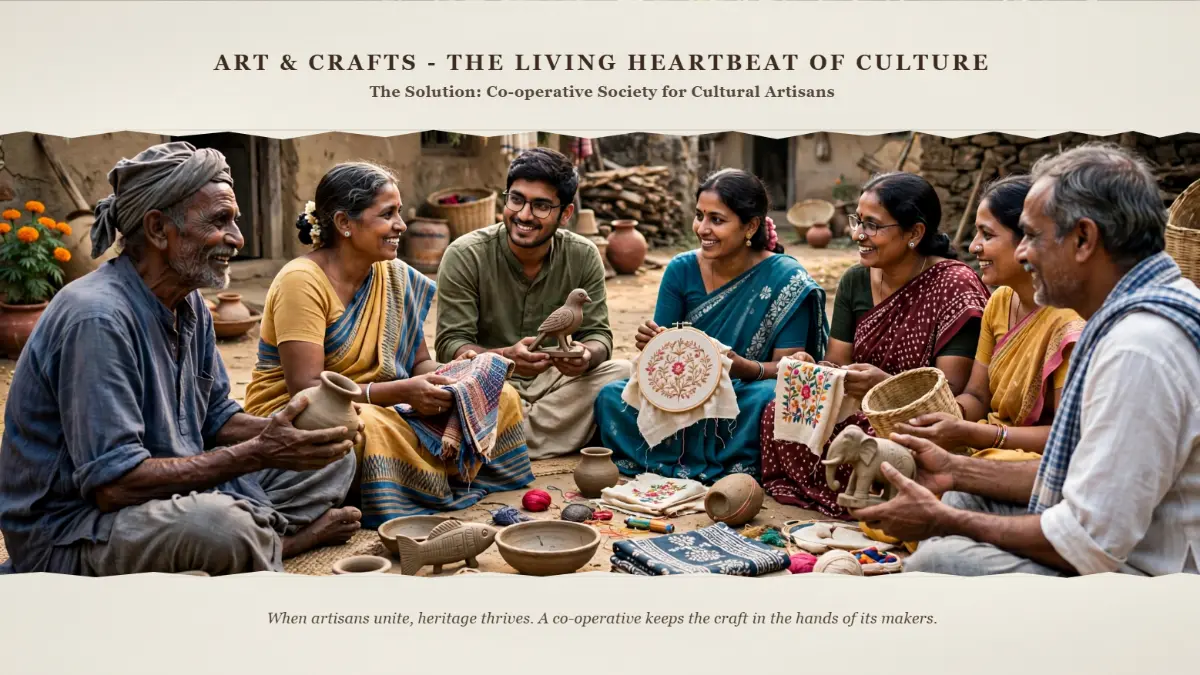
Art and traditional handicrafts are the core identity of any culture, connecting people to their roots while serving as a vital source of livelihood. In India, these crafts form one of the largest employment sectors after agriculture, supporting millions of families across generations.
For centuries, these skills were passed down naturally from hand to hand and heart to heart. However, this chain of inheritance is now breaking. As highlighted in Indian Cultural Art & Handicrafts: Why a Booming Market Is Losing Its Makers, the younger generation is stepping away from learning these cultural arts & crafts, seeing no stable future in continuing their cultural legacy.
This trend creates a glaring contradiction: if the market is growing, why are the makers leaving? On paper, the market is thriving – global demand is rising, export numbers are strong, e-commerce or online platforms are onboarding craft sellers, and government support schemes exist. Yet on the ground, the artisans themselves are struggling to survive.
A heavy reliance on middlemen, rising raw material costs, and poor and fragmented policy implementation leave makers with very low earnings, forcing many experienced artisans to leave their cultural trades for low-paying daily jobs.
2. Why Current Support Falls Short
The Indian government has introduced several schemes over the years, including cluster programs like SFURTI, the PM Vishwakarma initiative, Artisan Credit Cards, training workshops, grant support, and online portals like India Handmade. Alongside this, Indian startups have built digital products such as vernacular craft apps, cataloging tools, and marketplace platforms to bridge the tech gap. NGOs and social groups also help on the ground with design support and basic literacy, though most operate on a very small, localized scale.
Yet, these efforts still fall short because they expect traditional craftspeople to behave like modern business managers. An artisan’s true skill is in their craft, not in running digital ads, managing supply chains, or handling complex marketing:
Training builds skill, not market power: Workshops often teach basic craft techniques that artisans already know from their families. What they actually need is business knowledge, pricing power, and direct access to high-value buyers.
Credit without steady sales creates debt: Giving loans without guaranteed buyer demand can push low-income artisans into debt. When institutional bank credit is difficult to secure or service, artisans are forced back to local moneylenders just to keep working.
NGOs operate at small scale or create luxury bottlenecks: Most NGOs do impactful work, but their reach is limited to a few specific villages or clusters. Even when some help artisans reach national or global markets, the products are often positioned as costly – which keeps sales volumes small and fails to sustain regular, everyday livelihoods.
Startups face rural limits, leaving middlemen in control: Many tech startups struggle with remote rural logistics, digital literacy barriers, and high listing costs. While products eventually reach urban buyers at high retail prices, intermediaries and platform layers capture most of the margin, returning only a fraction of the final value to the maker.
In short, support focuses heavily on production, loan grants, training, digitalisation, and initial tools. But the areas where actual money is made - pricing control, fair aggregation, and steady income security – are still neglected. Artisans continue to make the goods, while others capture the profit.
3. Lessons from What Works
India does not need to start from scratch. We already have indigenous models that proved how to solve key parts of this problem. The real challenge is that each model tackled only a specific piece of the value chain, leaving the others unaddressed:
3.1 Amul (Producer Ownership & Fair Returns)
Amul proved that small rural producers do not have to depend on exploitative middlemen. By organizing dairy farmers into a massive, producer-owned cooperative, the majority of the final retail price flows straight back to the makers. However, milk is a uniform daily staple with continuous consumption; handicrafts are creative, diverse goods with varied production cycles, requiring design adaptation and specialized marketing that a dairy-style procurement system cannot mirror.
3.2 Lijjat Papad (Decentralized Work & Central Raw Material Hubs)
Lijjat demonstrated that scaling production does not require centralized factories. Women produce goods right from their homes, while a common center procures and prepares raw materials in bulk. This central hub drastically cuts input costs, ensures consistent quality, and guarantees direct wages. However, Lijjat works because it produces a single food item with a fixed formula. Handicrafts span completely different crafts – from handloom weaving to pottery and metalwork – each requiring distinct raw materials, tools, and individual artistic styles.
3.3 Fabindia (Branding & Urban Market Linkage)
Fabindia showed the power of branding traditional products. Instead of manufacturing in corporate factories, they source directly from local artisans across India and adapt traditional crafts for modern urban and global consumers. It proved that customers will readily buy Indian handicrafts when backed by strong branding, standard quality, and retail access. But Fabindia remains a private commercial business; while it provides artisans with orders, the brand equity, retail margins, and enterprise profits belong to the corporation, not the makers.
3.4 KVIC / Khadi (Long-Term Institutional Survival)
Structurally, state funding, government procurement, and a network of district outlets have successfully preserved traditional crafts across generations, proving that institutional support can protect cultural heritage from market pressures. Operationally, however, the model fails to protect individual creators. This framework remains entirely dependent upon a vast network of independent cooperative societies, each with its own roadmap, which together fail to cover almost 90% of the actual artisan workforce. The vast majority of excluded artisans are left entirely on their own - receiving no raw material support, no social security coverage, and no institutional financial safety nets.
3.5 SEWA (Grassroots Organizing & Financial Resilience)
SEWA proved that organizing informal, home-based women workers into strong community collectives provides essential bargaining power, access to fair microcredit, and dignity. It shields artisans from debt traps and isolation. However, SEWA was created primarily as an advocacy, labor rights, and welfare organization; it lacks the aggressive commercial marketing, global supply-chain infrastructure, and high-volume retail network needed to scale globally.
Each model proved that a crucial part of the puzzle can work:
Amul solved producer ownership and direct profit returns.
Lijjat solved bulk raw material savings and home-based work.
Fabindia solved modern branding and urban retail access.
KVIC solved long-term institutional survival and support.
SEWA solved grassroots solidarity, social and financial safety.
Right now, an Indian artisan is trapped between these partial solutions. A maker might have community support (like SEWA) or decentralized home production (like Lijjat), but lack modern branding (like Fabindia). Or they might supply a recognized brand, but surrender all ownership of the profits (unlike Amul).
No single framework has brought artisan ownership, cheaper bulk inputs, modern branding, institutional resilience, and financial protection under one roof. Combining these proven strengths into one unified operational structure is the primary gap this policy brief aims to bridge.
4. The Proposal: An Integrated, Artisan-Owned Cooperative System
The policy proposal aims to build a cooperative-based system in which artisans take part in the entire value chain, from raw material to final sale, instead of remaining isolated producers. Production stays in the villages, preserving cultural skills and local flexibility, while aggregation, logistics, branding, and market access are managed collectively for scale and efficiency. Professional teams handle operations, but ownership and strategic control stay with the artisans.
4.1 Four Institutional Tiers
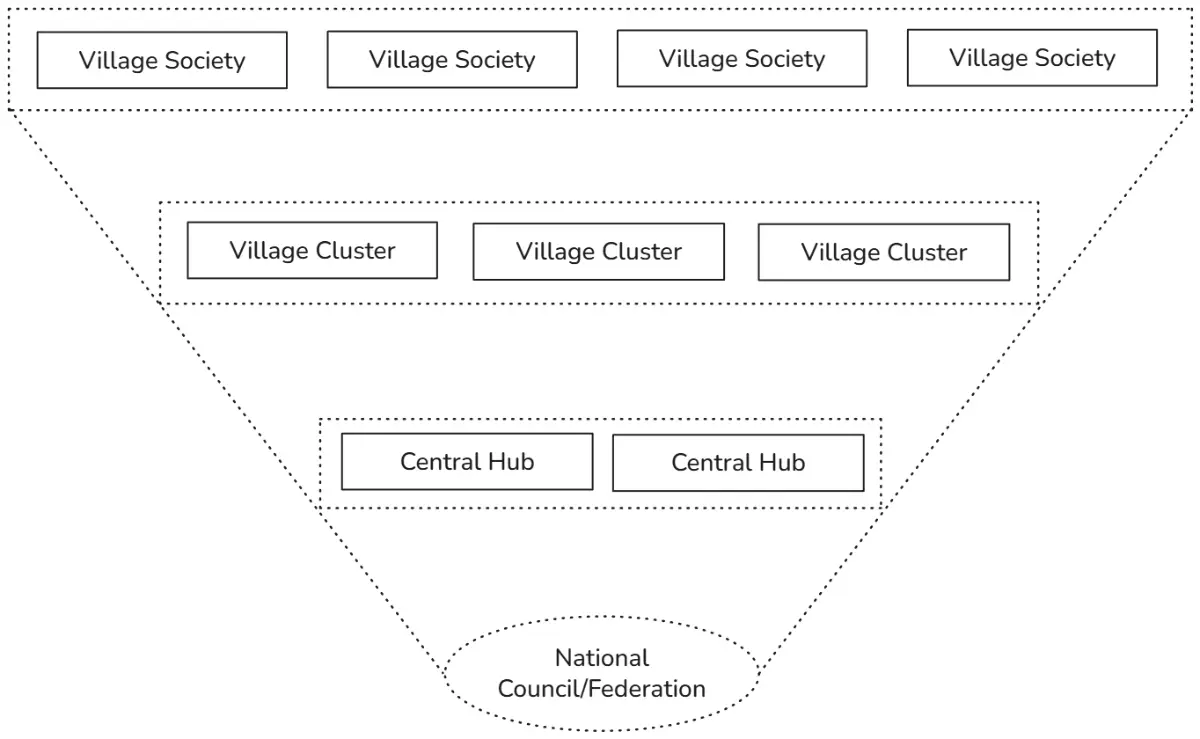
The system functions through four clear cooperative tiers:
Village-Level Societies: Base production units. They manage artisan records, verify authentic craft quality, register local demand for raw materials, and make direct, timely cash payments to artisans.
Cluster-Level Units: Regional coordination centers acting as a structural backbone. They handle distribution of raw materials to surrounding villages, and aggregate finished goods where local collection makes sense.
Central Hubs: Commercial engines. They handle warehousing, final finishing, packaging, branding, e-commerce listings, and logistics that connect village production and raw material procurement with bulk buyers and vendors.
National Federation/Council: The apex strategic body. It manages a unified national brand, establishes pricing frameworks, secures export partnerships, manages the security fund, and oversees risk protection across the entire system.
4.2 Five Functional Pillars
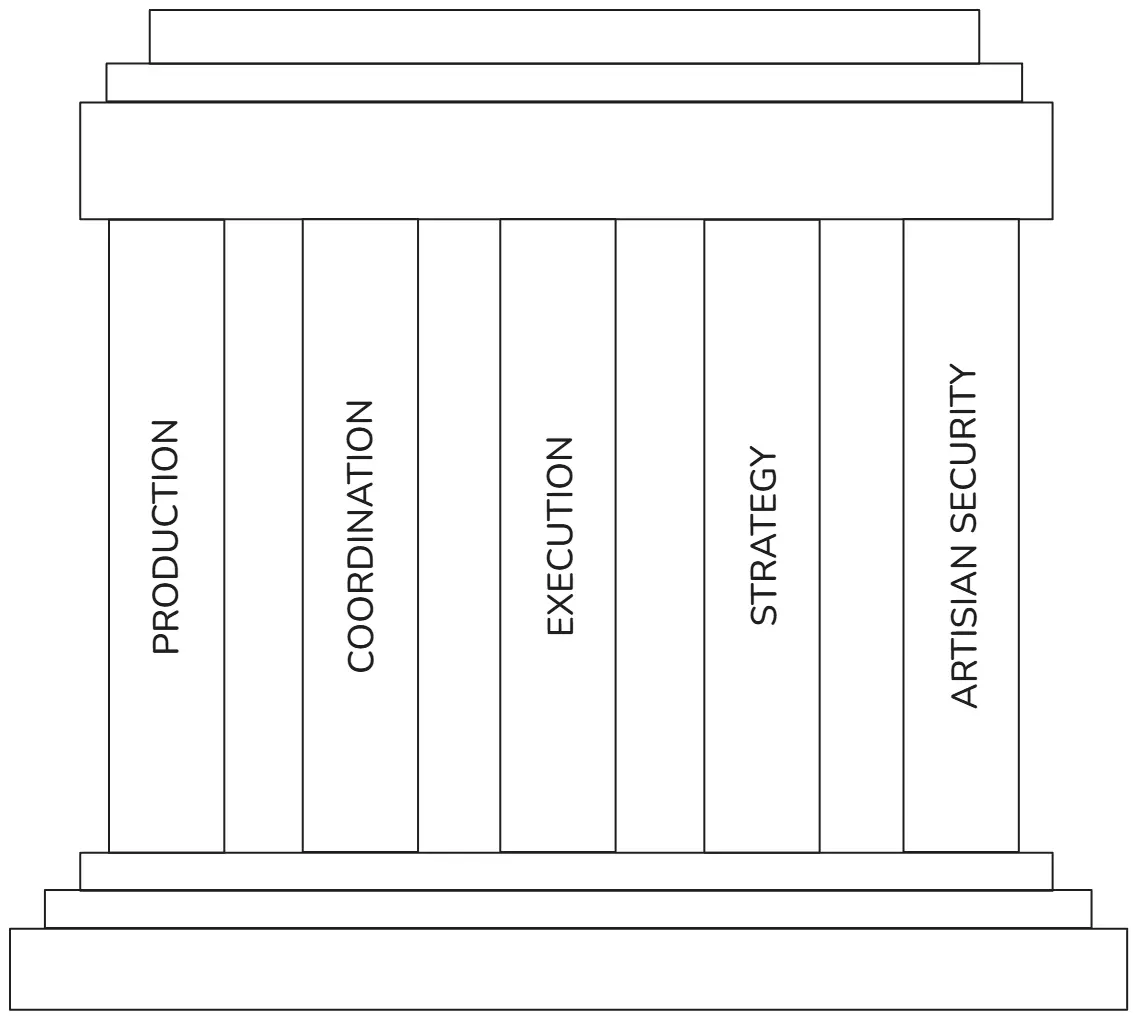
The framework rests on five functional pillars designed so business operations and social security work as one:
Production (Village Level): Retains traditional handmade skills while maintaining consistent product standards.
Coordination (Cluster Level): Organizes steady raw-material flow and reliable local aggregation.
Execution (Central Hubs): Manages commercial operations, professional branding, and supply-chain logistics.
Strategy (National Level): Drives national market reach, export channels, and long-term policy integration.
Artisan Security (Cross-Cutting): Operates across every level, ensuring fair baseline wages, health support, and financial resilience for every registered maker.
5. How the System Works
The framework operates through these continuous flows:
5.1 Goods flow
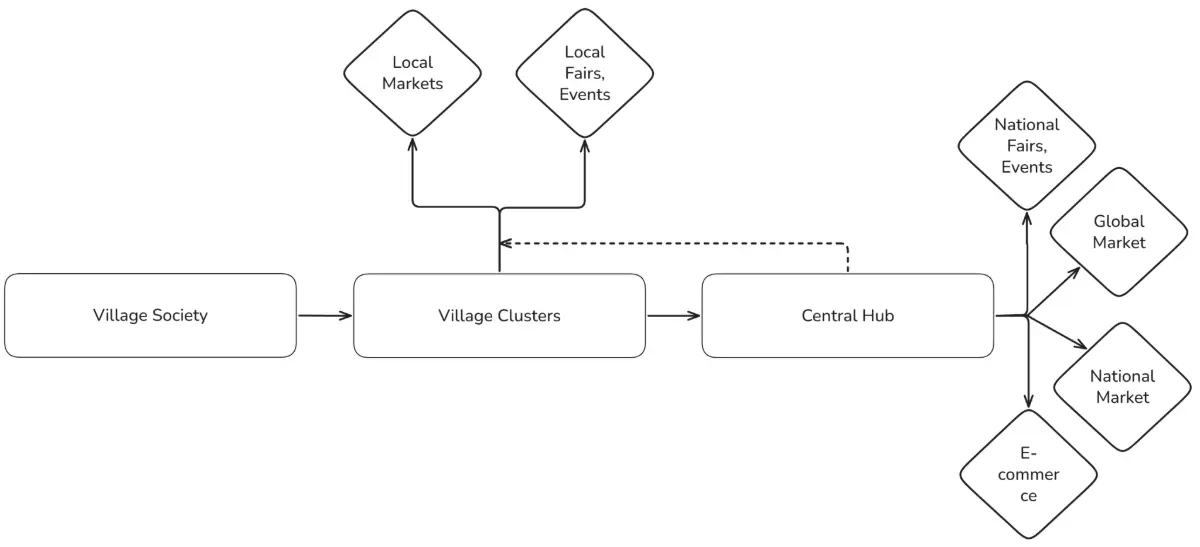
Products move from village societies to cluster units (only where aggregation improves efficiency), then to central hubs, and finally to local, national, and global markets, including e-commerce.
Goods flow from village societies to markets
5.2 Information flow
Production data and ground-level challenges move up the system, while market demand, pricing signals, and strategy move down. This continuous loop keeps production aligned with real demand and reduces overproduction. Here "Top" is refers to the national council and "Bottom" is refers to Village Societies.
Bottom-up: Production data, artisan challenges, and local insights
Top-down: Market demand, pricing signals, and strategic direction
5.3 Security flow
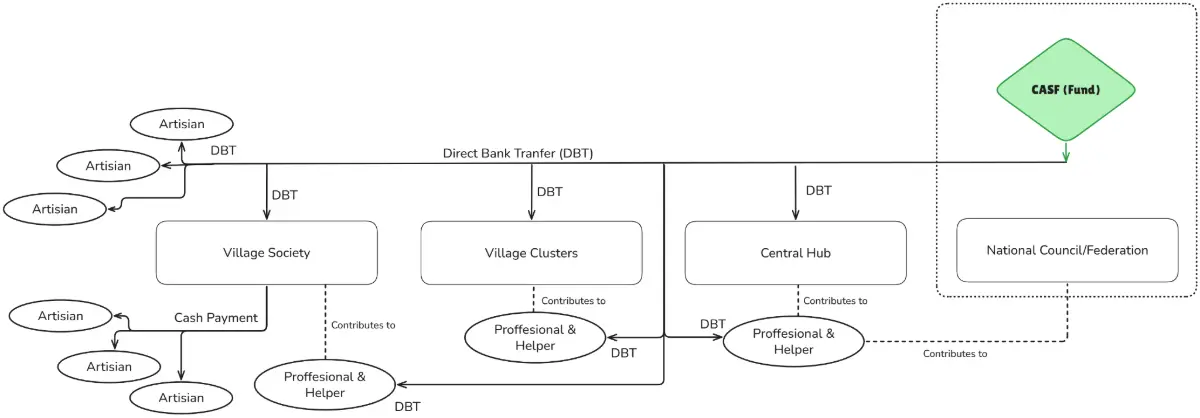
Risks identified at the village level move up through clusters and hubs and are addressed at the national level through the Common Artisan Security Fund, which supports income stabilization, insurance, emergency assistance, and protection against climate and demand shocks. Payments reach artisans primarily through direct bank transfers, with village societies managing cash disbursements only where banking access is limited.
Security flow and direct payments to artisans
5.4 Revenue Flow
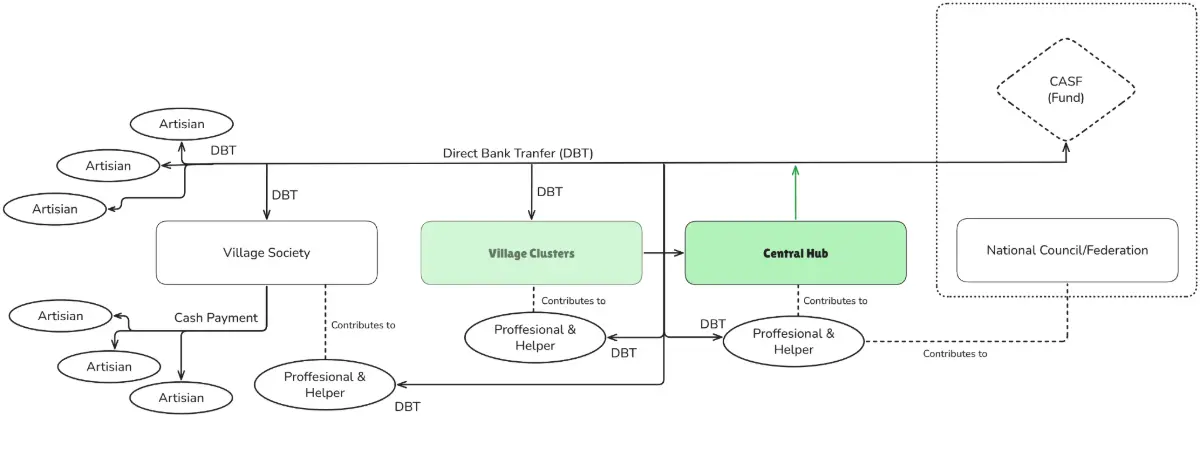
Revenue generated from sales flows back through central hubs and is distributed to artisans. A portion is allocated to the Common Artisan Security Fund for risk protection and long-term sustainability.
Revenue Flow Chart
6. Feasibility Assessment
To ensure this integrated cooperative model delivers real value to artisans rather than remaining a theoretical plan, it must be tested where local conditions are most viable.
6.1 Where to Start
Launching across the whole country at once would be risky. The model should begin in two or three regions where the conditions are right: strong traditional crafts, available artisans, local raw materials, low impact of machinery, basic infrastructure, and manageable operating costs.
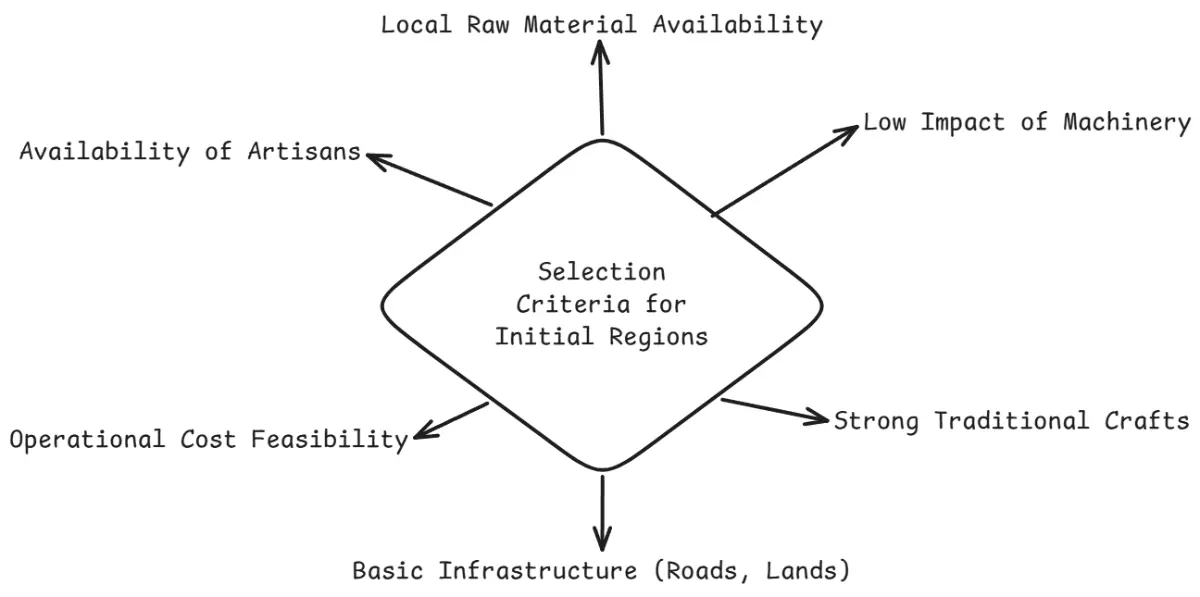
Selection criteria for initial regions
6.2 Operational Feasibility: The Kutch Pilot
Applying the above-mentioned criteria, Kutch in Gujarat meets these conditions. It has a high concentration of crafts such as Ajrakh printing, Rogan art, Kutch embroidery, Kala cotton, and copper bell making. Raw materials are available nearby, craft villages are well established, and the ports of Mundra and Kandla offer strong export access. Artisans here also know existing schemes and their limits, which makes them open to a better-integrated model.
Cluster 1: Northern
Villages covered: Dhordo, Khavda, Ludiya, Bhirandiyara, Hodka
Centre & distance: Bhirandiyara (~40–50 km from Bhuj)
Cluster 2: Central
Villages covered: Nirona, Zura, Sumrasar, Loriya
Centre & distance: Loriya (~20–25 km from Bhuj)
Central Hub
Villages covered: Bhujodi, Ajrakhpur, Bhuj, Kukma
Centre & role: Bhuj (hub for processing, branding, and market linkage)
Most villages fall within 10–40 km of their cluster centre, so goods can move in small or shared vehicles on fixed weekly or bi-weekly cycles. Artisans, especially women and home-based workers, can keep working in their own villages, while the Bhuj hub connects them to exhibitions, retail, digital platforms, and export routes through Mundra, Kandla, and Ahmedabad air cargo.
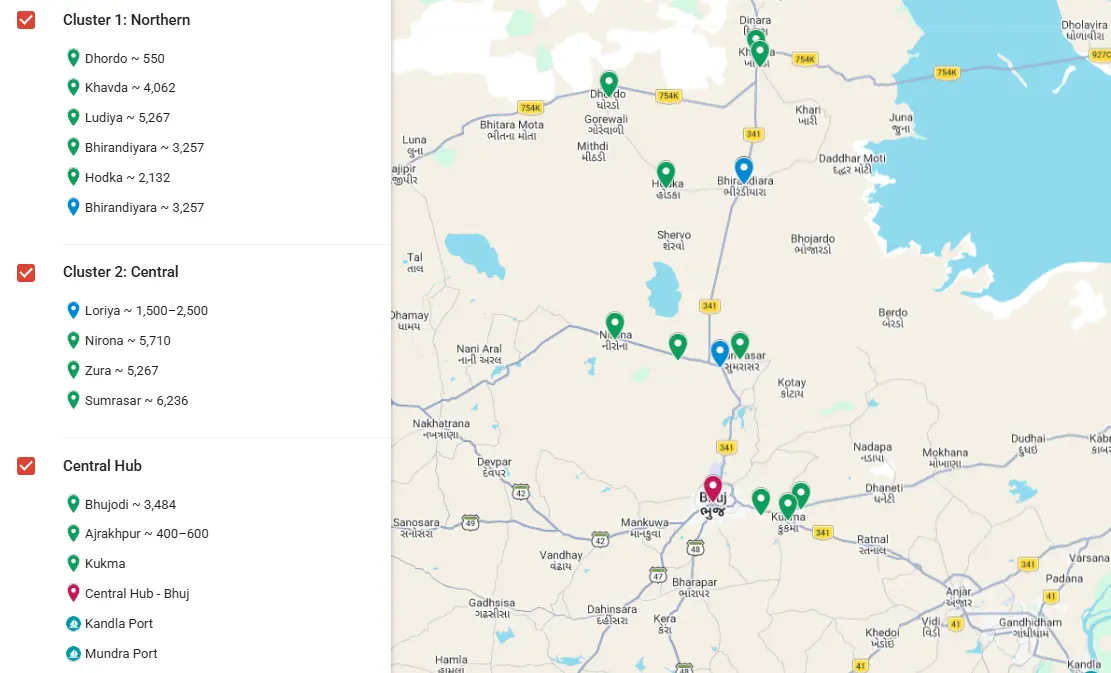
Feasibility on Map (Click Here)
6.3 Replicability Across Regions
Because the model builds on existing craft ecosystems, the same structure can be adapted to very different regions:
West Bengal
Key crafts: Terracotta, tant sarees, silk, Dokra, Chhau masks
Main gap addressed: Fragmented, trader-dependent production with low value realization
Bastar (Chhattisgarh)
Key crafts: Dhokra, wrought iron, wood carving
Main gap addressed: Strong skills but little aggregation or formal market access
Channapatna (Karnataka)
Key crafts: GI-tagged wooden lacquer toys
Main gap addressed: Falling incomes due to cheap, machine-made imports
Moradabad (Uttar Pradesh)
Key crafts: Brassware, metal handicrafts
Main gap addressed: Global demand exists, but value is predominantly captured by traders and exporters
6.4 Institutional Feasibility
The model does not need a new institutional setup. It works alongside existing handicraft and cluster schemes, uses existing cooperatives, self-help groups, and artisan groups as the base for village societies, and runs mostly at the village and cluster level, within current administrative structures.
6.5 Social and Behavioural Feasibility
Many artisans are tied to traders and may hesitate after seeing many schemes come and go. Trust can be built through consistent functioning, transparent payments, and visible results at the local level. Keeping production in the village supports the participation of women artisans, and a gradual, small-group start makes adoption realistic.
7. Implementation Roadmap
Implementation is divided into the phases below and adopts an agile rollout model.
Phase 1: Pilot
Key actions: Set up village societies, clusters, and one central hub in 1–2 regions; test operations and governance.
Phase 2: Expansion
Key actions: Scale to more clusters in the region; strengthen branding and market linkages; introduce export channels.
Phase 3: Consolidation
Key actions: Establish the National Federation; standardize processes and pricing frameworks; add new states.
Phase 4: National Scaling
Key actions: Keep scaling to other states or regions to build a nationwide network of artisan cooperatives with digital platforms and advanced logistics.
Across all phases, roles stay clear: the government enables through policy, infrastructure access, and simpler compliance; cooperatives own and govern the system; and professional managers within the cooperative handle logistics, marketing, and execution. A new region is added only once the previous one runs steadily.
8. Risks and Mitigation
Market: Slow or Fluctuating Demand
Mitigation: Start small with strong products, diversify crafts, balance domestic and export channels, and implement demand forecasting.
Operational: Logistics Inefficiency
Mitigation: Optimize cluster locations and transit routes, paired with professional management of daily operations.
Income: Irregular Earnings
Mitigation: Establish a Common Artisan Security Fund for income stabilization and emergencies.
Governance: Concentration of Power
Mitigation: Mandate elected representation, role rotation, regular audits, and transparent reporting systems.
Adoption: Hesitation from Artisans
Mitigation: Drive community awareness, hands-on training, active engagement, and showcase early success stories.
External: Climate and Global Market Pressures
Mitigation: Build craft and market diversification and establish risk buffers at the national federation level.
9. Measuring Success and Expected Outcomes
Progress will be tracked through artisan income levels, participation rates, production volume and consistency, market reach, and reduced dependence on intermediaries. Data will be collected digitally at the village level, audited at the cluster and hub levels, and reviewed annually at the national level.
The expected outcomes are stable and fairer incomes, less dependence on middlemen, wider access to national and global markets, the revival of traditional crafts, and greater dignity and social status for artisans.
10. Policy Recommendations
Create an enabling framework for multi-tier artisan cooperatives, with simplified registration and compliance for village societies, cluster units, and central hubs.
Channel existing schemes through the cooperative system, so that cluster, skill, credit, and marketing schemes reach artisans as one connected package instead of separate pieces.
Establish a Common Artisan Security Fund at the federation level for income stabilization, insurance, and emergency support.
Build a shared national brand and digital sales channels, managed by the federation, so that the value of the brand returns to artisans.
Make payments and data transparent, with digital tracking of production and sales and direct bank transfers to artisans.
Scale region by region instead of in one go.
11. Conclusion
India does not lack demand for its crafts, nor does it lack schemes to support them. What it lacks is a system that connects the two. As long as artisans stay confined to production, the value of their work will keep leaking to others, and the next generation will keep walking away.
This policy offers a different path: artisans who own their institutions, sell through their own brand, and are protected by a shared safety net. Because if we want our crafts to survive, we must first make sure that the hands that create them can survive.